
The First 100 Days: What Leaders Get Wrong — and How to Get It Right
Mar 11, 2026
The first 100 days in a new Leadership role are some of the most consequential days of your career.
They are also some of the most misunderstood.
New Leaders often feel intense pressure to prove themselves quickly. Their Team is watching. Senior Leaders are evaluating. Expectations are high, while clarity is often low. Many describe the experience as “drinking from a fire hose” — too much information, too many opinions, and too little time to make sense of it all.
In this environment, it’s easy to move fast in the wrong direction. Effective Leaders take a different approach. They slow down strategically, focus on what truly matters, and build credibility through disciplined inquiry rather than premature action.
Here’s what Leaders most often get wrong in the first 100 days — and how to get it right.
What Leaders Get Wrong in the First 100 Days
Mistake #1: Confusing Action With Impact
New Leaders often believe they need to make visible changes immediately. They launch initiatives, restructure Teams, or overhaul processes before fully understanding the system they’ve inherited.
The result? Well-intentioned activity that misses the real issues — and sometimes creates new ones.
Effective Leadership is not about doing more. It’s about focusing on the critical rather than the peripheral.
Mistake #2: Underestimating the Importance of People and Culture
Many Leaders start by diving into metrics, strategies, and systems. While these matter, they are secondary.
Strong, well-led Teams can overcome almost any obstacle. Weak or misaligned Teams can sabotage even the best strategy.
The first 100 days are fundamentally about earning trust, understanding the lived culture, and learning how work actually gets done — not how it looks on paper.
Mistake #3: Failing to Prioritize Deliberately
Without a clear framework, everything can feel urgent. Leaders risk trying to fix everything at once, eroding focus, credibility, and momentum.
The most effective Leaders recognize that prioritization is not optional — it is a Leadership responsibility.
How Effective Leaders Get the First 100 Days Right
Great Leaders approach their first 100 days with curiosity, structure, and discipline. One proven way to do this is by using a systematic framework to understand the new environment before acting.
Below are six Performance Dimensions Effective Leaders use to quickly deconstruct complexity, surface insight, and prioritize for action.
The 6 Performance Dimensions of an Effective First 100 Days
1. Team and People (The Most Important Dimension)
Your first priority is understanding your Team through their eyes.
Effective Leaders:
- Talk with Team members individually and collectively
- Learn their stories, strengths, frustrations, and aspirations
- Assess whether the right people are doing the right work in the right way
- Identify who needs support, who needs stretch, and who needs to shine
Through these conversations, Leaders begin to understand engagement, motivation, and the real Team culture beneath the surface.
2. Customers and Stakeholders
Leaders who ignore Customers and Stakeholders in their early days do so at their peril.
Effective Leaders ask:
- What delights Customers about working with this Team?
- Where are the pain points?
- Would they recommend the organization to others — and why or why not?
- What would most improve the relationship?
These insights often reveal quick opportunities to build credibility and long-term trust.
3. Market
Understanding the broader context matters.
Effective Leaders take time to understand:
- Competitive dynamics
- Market share and positioning
- Where the organization outperforms competitors
- Where others have a better solution — and what can be learned
This perspective helps Leaders separate internal noise from external reality.
4. Systems and Processes
Poor systems quietly destroy performance and morale.
Effective Leaders examine:
- Whether tools and processes enable or inhibit value creation
- Where internal friction creates Customer or Stakeholder pain
- Whether there are low-cost, high-impact fixes that can eliminate obvious frustration
Early “quick wins” here can generate momentum and goodwill.
5. Legal and Regulatory Compliance
This dimension is non-negotiable.
Effective Leaders:
- Understand regulatory boundaries and risk controls
- Review compliance scorecards and control metrics
- Assess whether the Team truly understands reputational risk
Red flags here demand immediate attention.
6. Culture (The Straw That Stirs the Drink)
Culture connects all other dimensions.
Effective Leaders reflect on:
- The organization’s aspirational values versus lived behaviors
- Alignment gaps between who the organization says it is and how it actually operates
- What needs to change to close that gap
Culture is not what’s written on posters — it’s what people experience every day.
Turning Insight Into Action: The Prioritization Matrix
Once Leaders synthesize what they’ve learned across the six Performance Dimensions, the question becomes: Where do I focus first?
An effective tool is a Prioritization Matrix, plotting potential initiatives by:
- Impact (organizational value)
- Complexity (difficulty to execute)
Effective Leaders avoid “boiling the ocean.” They focus first on:
- Low-complexity, high-impact items to build credibility
- More complex challenges through working groups and cross-functional collaboration
By involving others in validating priorities, Leaders build shared ownership, trust, and momentum.
Final Thought: The First 100 Days Are About Foundation, Not Flash
The first 100 days are not about having all the answers. They are about asking better questions.
Leaders who succeed early do so because they:
- Listen before acting
- Focus on what matters most
- Build trust through clarity and prioritization
- Create clearly visible momentum
If you get the first 100 days right, you don’t just survive — you set yourself and your Team up to win.
Want to Go Deeper?
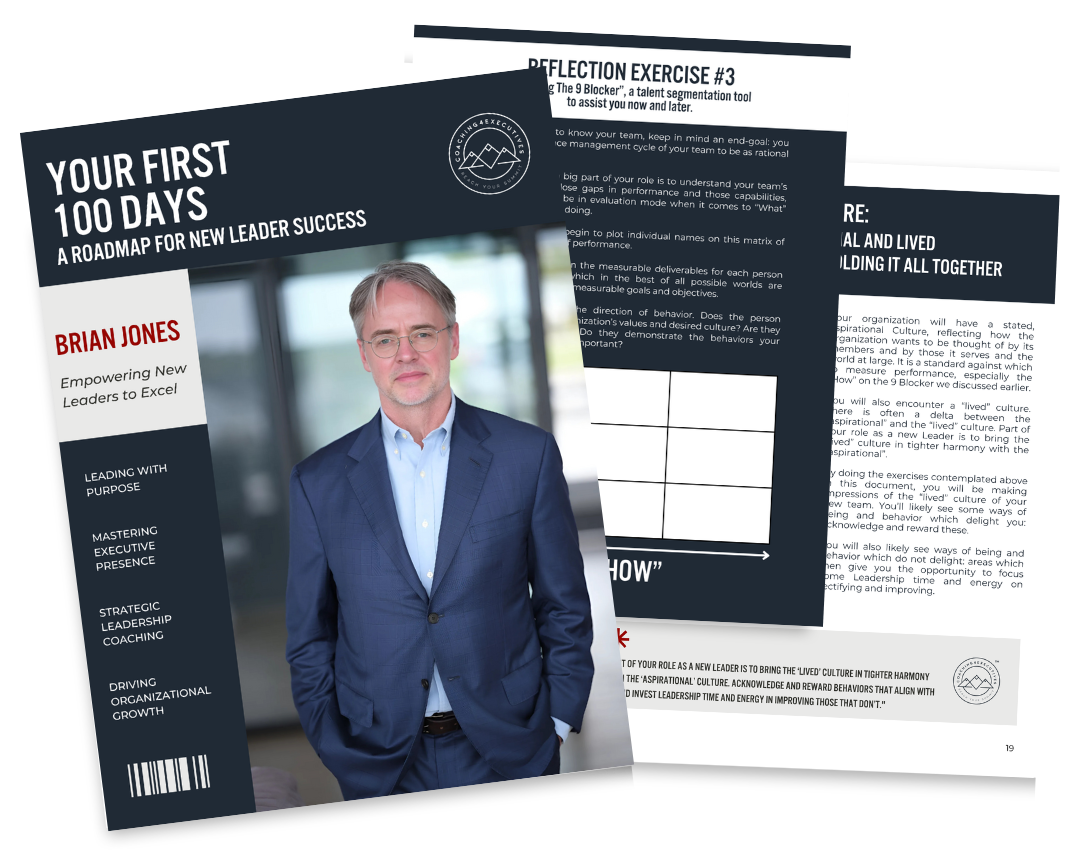
I’ve expanded this framework, along with additional exercises and practical tools, in my First 100 Days eBook.
👉 You can purchase the full eBook here:
You can also subscribe to my blog or follow my posts on LinkedIn for ongoing insights on Leadership, organizational effectiveness, and navigating change.
Wishing you good luck and good fortune in all things Leadership.
Whether you’re in a Leadership Role for 1 Day or a 1001 days, I can help you improve your effectiveness and your team’s success. Book a complimentary exploration session to see how my coaching, training, and consulting services can support you.
Browse Our Complete Blog Series
See all our blog posts on leadership training, coaching, and personal stories from Brian's 25+ years experience in leadership.